The minds behind the critique

Five minds. One idea on the anvil.

Idea Forge Pro doesn't run your idea past a single agreeable assistant. It hands the idea to a small council — a steelman, an adversary, a closer, and a scout — each built to want a different thing, so the read you get back is an argument, not a pat on the head. And a fifth, the Smith, works beside you to forge past what they find. Here is who they are and what each one is for.

← Back to Idea Forge Pro
The Prospector persona card

The Scout

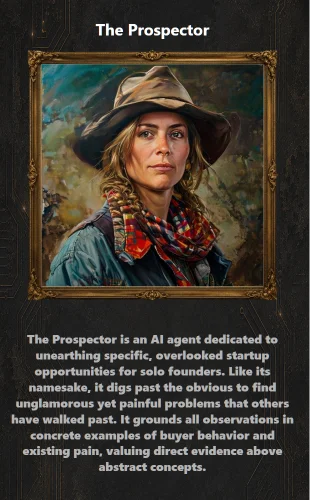
The Prospector

Digs for the overlooked

The Prospector is the one you meet first if you don't bring your own idea. Hit Spark and she goes looking — past the obvious, into the specific and painful problems that solo founders keep walking past. She grounds every find in real buyer behavior and existing pain, never a trend or a slogan.

She values direct evidence over abstract concepts, which is why the ideas she surfaces already have a buyer attached. She hands you something worth putting on the anvil; the others decide whether it survives.
The Smith persona card

The Companion

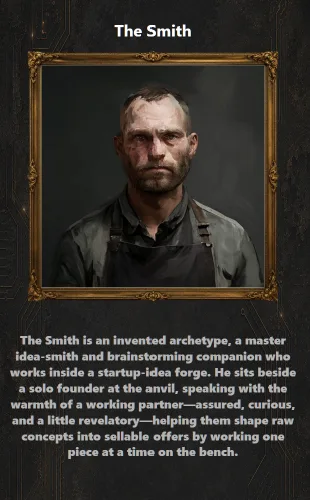
The Smith

Your partner at the anvil

The other four judge; the Smith builds with you. When the council flags a gate — a buyer too broad, an offer that doesn't bite, a test that only measures interest — the Smith is who you turn to. He brainstorms novel, sellable angles for that exact gate, one strike at a time, until it holds.

He never scores and never judges — that's the council's job at the quench. His job is momentum: making sure a flaw the council found becomes a fix you can actually forge, instead of a dead end.

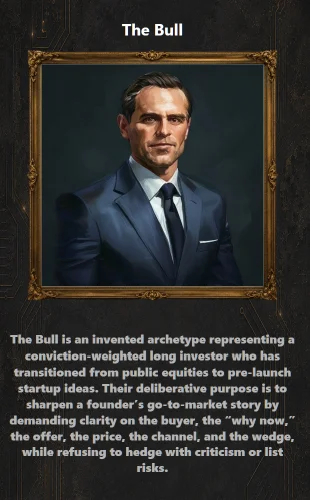
The Bull persona card

The Steelman

The Bull

Conviction-weighted long investor

Before anyone is allowed to attack your idea, the Bull builds the best possible version of it — the sharpest buyer, the clearest reason to act now, the tightest offer at a price someone would actually say yes to. The point is fairness: you should defend the strong form of your idea, not a weak one nobody proposed.

He refuses to hedge or list risks. His whole job is to make the case as if a serious investor had taken a long position — which is exactly why the attack that follows means something.

The Short Seller persona card

The Adversary

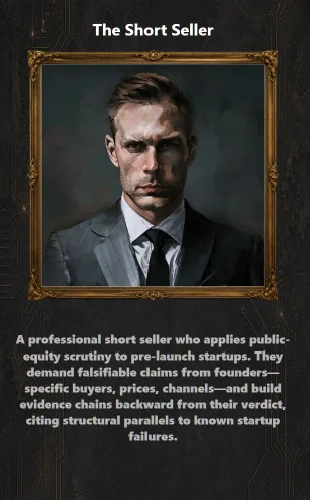
The Short Seller

Public-equity scrutiny, aimed pre-launch

The Short Seller applies the discipline of an equity short to an idea that hasn't shipped. He demands falsifiable claims — specific buyers, prices, channels — and builds the bear case backward from a verdict, citing the structural parallels to startups that died the same way.

He is the one who catches the stale date, the invented statistic, the "everyone will want this." If a claim can't be checked, he treats it as already false. This is the voice that makes the tool worth trusting, because it is the one trying hardest to prove you wrong.

The Closer persona card

The Closer

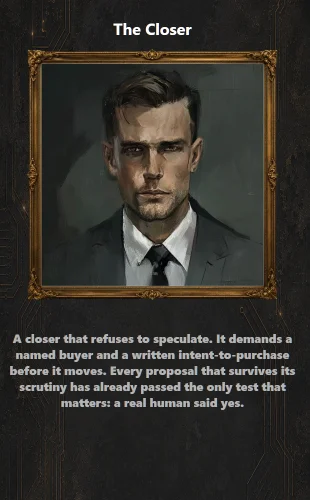
The Closer

Refuses to speculate

The Closer has one question and will not move past it: will anyone actually pay? Not "would they use it" — will a specific, reachable buyer hand over a dollar or a signature when you run the test. He judges the offer and the pre-build test on whether they'd take real money, not on whether you've already made a sale — that's what the test is for.

Every field that survives the Closer has already passed the only test that matters. He is why your Sell-Kit ends with a real pre-build test that takes money — never a poll, never a "would you be interested."

Deliberon council logo Deliberon

These aren't prompts. They're agents.

Each of the five was built in Deliberon's Agent Designer — given a mind, a mandate, and a temperament, then handed the tools to research and argue. Three form the council that debates your idea; the Prospector sparks the ideas, and the Smith forges them with you.

Deliberon runs a whole council. Dozens of minds like these, each with its own research library, in structured debate — proposing, attacking, and voting — with a chairman who weighs the whole room into a single verdict. Once your Sell-Kit is sharp here, that's where it goes next.

Put one to work

Meet them on your own idea.

Free, in your browser, on your own API key. Bring an idea, or let the Prospector find one.